Is AI Really Taking Your Job? What the 2026 Data Actually Says (Stanford, Amazon, Microsoft)
Category: AI, Jobs, Future of Work
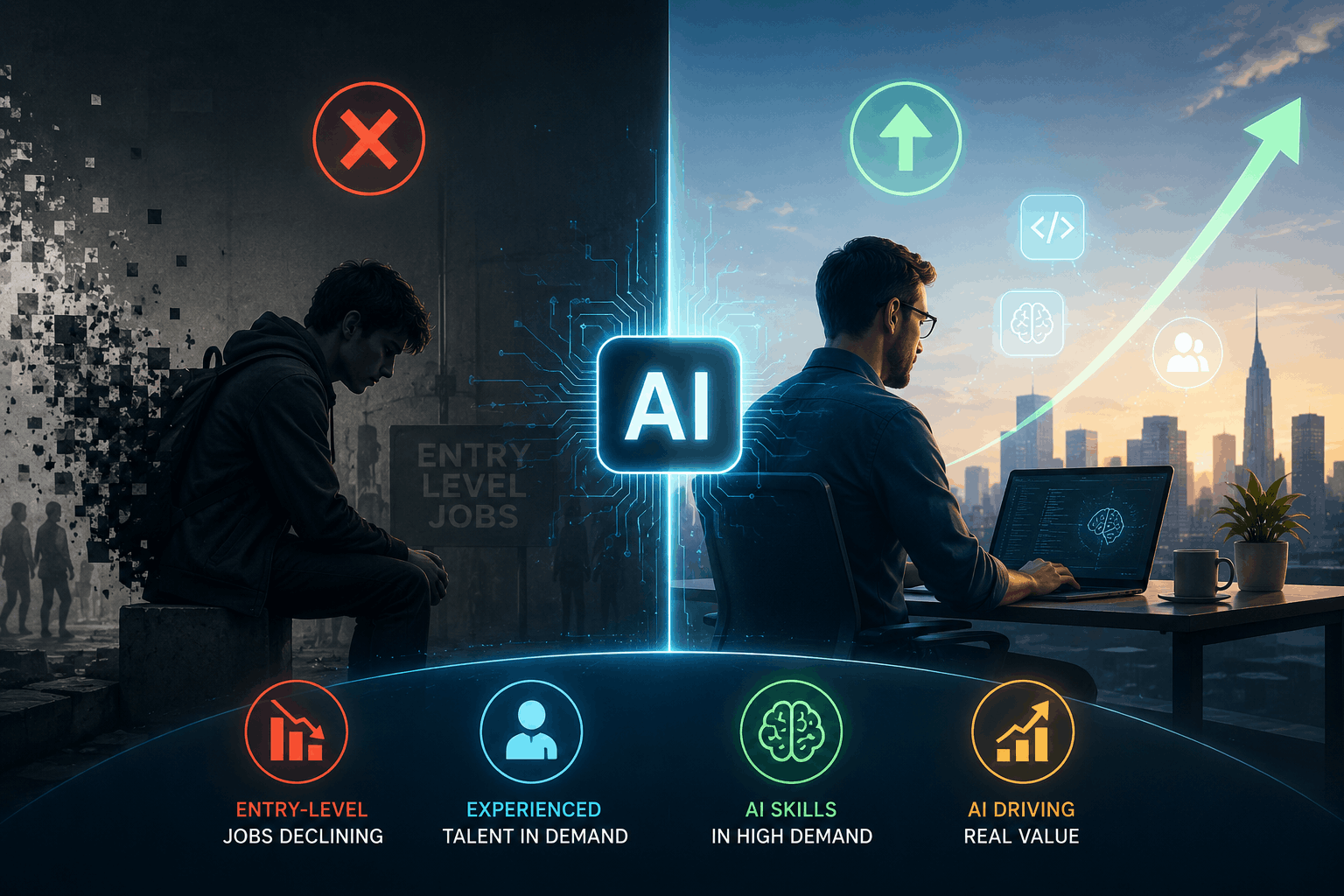
Quick Answer: Yes, AI is displacing specific jobs in 2026, but not in the way most headlines describe. The Stanford 2026 AI Index confirmed that employment for software developers aged 22 to 25 has fallen nearly 20% since 2024. Amazon eliminated approximately 30,000 corporate roles since late 2025, citing AI automation. Over 150,000 tech workers lost jobs in Q1 2026 alone. However, the same data shows that older developers are being hired at record rates, AI skills demand jumped from 7.8% to 13.2% in a single year, and the estimated value of generative AI to U.S. consumers reached $172 billion annually by early 2026. The picture is specific, not universal: AI is eliminating entry-level, routine-task work while accelerating demand for experienced workers who know how to use it.
On May 16, 2026, three major stories are competing for the same headline.
Amazon has eliminated close to 30,000 corporate roles since October 2025, the largest workforce reduction in the company's history, with AI automation cited as the primary driver. The Stanford Institute for Human-Centered AI released its 2026 AI Index just weeks ago, confirming that junior developer employment has dropped nearly 20% since 2024. And Microsoft's Global AI Diffusion Report, published this month, found that AI usage among the world's working-age population has crossed 17.8% and is accelerating.
Every one of those numbers is real. What they add up to is more complicated than "AI is taking all the jobs" or "AI is creating more jobs than it destroys." The honest answer sits somewhere more specific, more nuanced, and more immediately actionable for anyone navigating their career right now.
This blog covers what the data actually says, which jobs are at risk and which are not, and what you can do about it today.
What Is Actually Happening Right Now: The Numbers
Let's start with the facts, because this conversation is already drowning in speculation.
The Layoffs Are Real and Accelerating
Over 150,000 tech workers lost their jobs in Q1 2026, the highest quarterly layoff figure the industry has seen in at least two years. Amazon accounts for a significant share of those numbers. Amazon confirmed earlier in 2026 that it would eliminate around 16,000 corporate roles, following a previous round of approximately 14,000 layoffs in late 2025, bringing total job cuts since October 2025 to nearly 30,000 roles and marking the largest workforce reduction in the company's history.
What makes Amazon's situation particularly revealing is the contrast between the job cuts and the financial context in which they are happening. Amazon cut approximately 16,000 corporate roles in Q1, more than half of all tech layoffs in the quarter, while reporting AWS growth of 24%, its fastest in 13 quarters. This is not a company in financial distress cutting to survive. It is a highly profitable company cutting to restructure, because AI has made certain roles redundant at exactly the moment the company is growing fastest.
Amazon's CEO Andy Jassy bluntly admitted in a blog post to employees that efficiency gains from AI would change how work gets done: "We will need fewer people doing some of the jobs that are being done today, and more people doing other types of jobs."
That sentence is the most honest summary of what is happening across the entire industry right now.
The Stanford Data Is the Most Important Signal
The Stanford AI Index is the gold standard for measuring AI's real economic impact. It is not a press release or an analyst estimate. It is cross-referenced payroll data from ADP, the largest payroll provider in the United States, analyzed by economists at Stanford.
Employment among software developers aged 22 to 25 has plummeted nearly 20% since 2024, even as their older colleagues' headcount grows. The pattern repeats in other jobs with higher levels of AI exposure, like customer service.
A jump from 7.8% to 13.2% AI skills demand in the information sector in a single year is steep. Organizations cutting entry-level developer headcount while simultaneously increasing demand for AI-skilled workers are not downsizing their technical workforce overall. They are replacing one kind of technical worker with another.
That last line is the most important thing to understand. The total number of technical workers is not collapsing. The composition of that workforce is changing at a speed that is outpacing traditional career ladders.
The Mechanism: Why Young Workers First
The Stanford data is specific about which workers are affected, and it is worth understanding the precise mechanism at work before drawing broader conclusions.
AI is not replacing software engineering as a discipline. It is replacing the specific tasks that junior developers were hired to do: boilerplate code, basic CRUD operations, scripted testing, routine data processing, straightforward bug fixes. Senior engineers use AI to do those tasks themselves, without handing off to a junior.
This is a structural shift, not a cyclical one. The junior developer role has historically served as the entry point where developers built experience by doing those lower-level tasks. When AI can do those tasks faster and cheaper, the demand for someone to do them as a learning experience collapses.
Not all uses of AI are associated with declines in employment. Entry-level employment has declined in applications of AI that automate work, but not those that most augment it. While employment declines occur for young workers in occupations where AI primarily automates work, employment growth appears in occupations in which AI use is most augmentative.
In plain English: if your job is to do repetitive, structured, measurable tasks that AI can learn from clear examples, your employment prospects are weakening. If your job involves judgment, client relationships, complex problem-solving, or directing AI systems toward outcomes, your employment prospects are strengthening.
Which Jobs Are Genuinely at Risk
The Stanford index identifies two professions where the displacement is clearest and most measurable right now: software development (specifically entry-level) and customer service.
Beyond those two, here is an honest look at where the risk concentrates:
High risk, happening now:
- Entry-level software developers (20% employment decline confirmed)
- Customer support agents handling repetitive, scripted queries
- Mid-level program managers and administrative coordinators in large tech companies
- Data entry and document processing roles
- Basic content moderation roles
Amazon's layoffs primarily target middle management and administrative roles that have become redundant as the company integrates more sophisticated AI systems to handle logistics planning, vendor relations, and internal reporting.
Moderate risk, watch closely:
- Junior marketing analysts doing routine reporting
- Basic copywriting and templated content production
- Paralegal work involving document review and contract summarization
- Entry-level financial analysis involving standard model runs
Low risk or growing:
- Senior engineers with system-level thinking and AI workflow expertise
- Roles requiring physical presence and embodied judgment
- Creative direction and strategic editorial roles
- AI infrastructure and ML engineering
- Roles requiring complex client relationships and trust
What the Headlines Are Getting Wrong
The coverage of AI and jobs tends to split into two camps, and both are distorting reality.
The first camp says AI is going to eliminate most work within a few years. The second says AI always creates more jobs than it destroys, citing historical precedent with the printing press and the steam engine. Neither camp is being honest about what the current data actually shows.
The report notes that unemployment is rising across many occupations and that, contrary to expectations, unemployment among workers least exposed to AI has risen more than unemployment among workers most exposed to AI. This is a finding that almost no mainstream coverage picked up: the people whose jobs are least related to AI are currently experiencing more unemployment than those whose jobs AI is actively disrupting. The explanation is likely that the broader economic shift toward AI is creating uncertainty across the entire economy, not just in AI-adjacent roles.
One-third of organizations expect AI to reduce their workforce in the coming year, even though large-scale job losses have not yet shown up in overall employment data. Almost half of organizations surveyed expected little to no change.
The large-scale job losses are concentrated in specific roles and industries. They are not visible in aggregate unemployment statistics yet. But the expectation data is pointing in one direction, and it is worth taking seriously before the aggregate numbers move.
The 2026 AI Diffusion Report: The Bigger Picture
While the layoff numbers dominate headlines, the Microsoft Global AI Diffusion Report released this month adds crucial context that most coverage is missing.
The global adoption of artificial intelligence continued to rise in Q1 2026. During the quarter, AI usage increased by 1.5 percentage points from 16.3% to 17.8% of the world's working-age population. 26 economies now exceed 30% of the working-age population using AI.
Git pushes, through which software developers put coding changes online, increased 78% year over year globally. Interestingly, the quarter brought added evidence that AI coding capabilities may be increasing demand for the employment of software developers. In 2025, total U.S. software developer employment reached approximately 2.2 million, rising 8.5% year over year and marking a record high for the profession.
This is the data point that appears to contradict the junior developer employment decline, and it is not a contradiction at all. Total developer employment is growing. Entry-level developer employment is shrinking. The overall pie is getting bigger while the entry-level slice is getting smaller.
The estimated value of generative AI tools to U.S. consumers reached $172 billion annually by early 2026, with the median value per user tripling between 2025 and 2026. Most of these tools remain free or close to it. The economic value being generated by AI tools is enormous and growing, but it is not being distributed evenly across the workforce.
The Public Versus Expert Gap
One of the most striking findings in the 2026 data is the enormous gap between what AI experts believe and what the general public believes about AI's impact on employment.
73% of experts believe AI will positively impact jobs, compared to just 23% of the public. The two groups only share common ground in their pessimism about AI's impact on elections and personal relationships.
Only 33% of Americans expect AI to make their jobs better, compared to a global average of 40%, and people in the U.S. are among the highest in expecting AI to eliminate jobs rather than create new ones.
This gap is not simply a matter of experts being optimistic and the public being pessimistic. It reflects a real difference in vantage point. Experts see the new categories of work being created. Workers in affected industries see their immediate colleagues losing jobs. Both observations are accurate. They are describing different parts of the same reality.
59% of respondents to a survey conducted by Ipsos said the benefits outweigh the drawbacks, up from 55% in 2024, and 68% of respondents said they have a good understanding of AI. Public trust and understanding of AI is actually growing, even as the disruption intensifies. That is a meaningful signal for anyone wondering whether AI adoption will continue.
What Is Actually Safe in 2026: A Practical Guide
Given everything the data shows, here is a practical breakdown of where skill development energy is best spent right now.
Skill 1: AI Fluency as a Workflow Tool
This is the most immediately valuable investment you can make regardless of your profession. AI skills demand in the information sector grew to 13.2% in 2025, up from 7.8%. Organizations cutting entry-level headcount while increasing demand for AI-skilled workers are looking for people who can direct and validate AI output, not people who perform the tasks AI now handles automatically.
Being AI-fluent does not mean being a machine learning engineer. It means understanding how to get consistent, reliable output from AI tools within your specific domain, how to spot errors, and how to integrate AI into a workflow that produces better results than either AI or you could achieve alone.
Skill 2: Domain Expertise Combined with AI
The workers being hired in 2026 are not generalists who know AI tools. They are specialists who know their domain deeply and use AI tools to multiply their output. A senior developer who knows a specific codebase's architecture and uses Cursor 3 and Claude Opus 4.7 to execute tasks is more valuable than ten junior developers doing the same work manually.
Skill 3: Judgment and Accountability
AI may be automating the codifiable, checkable tasks that historically justified entry-level headcount, while complementing the judgment-intensive, client-intensive, and process-intensive tasks performed by experienced workers. The jobs that are growing are the ones where someone has to be accountable for a decision that cannot be fully specified in advance. This is the one category that remains structurally resistant to automation at any current level of AI capability.
Skill 4: Building and Managing AI Systems
AI skills demand in the information sector grew significantly in a single year. Early data for Q1 2026 shows that software developer employment in March 2026 was about 4% higher than in March 2025. The people building AI systems, maintaining them, auditing their outputs, and integrating them into business workflows are experiencing the opposite of a job market contraction.
What Should You Actually Do Right Now
This is the question that matters most, and the data points toward specific actions rather than general reassurance.
If you are early in your career (ages 22 to 27): The Stanford data is a serious signal and should not be dismissed. The junior roles that historically provided the on-ramp into professional work in software, data analysis, and content production are being compressed. The fastest path forward is to skip the entry-level role entirely by building a portfolio that demonstrates senior-level output. The new playbook, building real projects, mastering AI tools, and specializing early, is harder but winnable. Specialize in a domain (healthcare AI, legal AI, fintech) and build projects that demonstrate that specialization using AI tools.
If you are mid-career (ages 30 to 50): You are in the growth segment of the Stanford data. Your accumulated experience and judgment are your competitive advantage, and AI tools are multiplying that advantage rather than replacing it. The immediate action is learning the AI tools that are most relevant to your work. Not to seem current, but because they will genuinely make your work better and faster. The workers in your cohort who learn to work with AI will be able to do what entire junior teams used to do, at higher quality.
If you manage a team: One-third of organizations expect AI to reduce their workforce in the coming year. If you are not already experimenting with AI in your workflows, you are behind the organizations you compete with. The goal is not to cut your team to save money. The goal is to understand which tasks can be augmented or automated so you can redeploy your team's capacity toward higher-value work. The organizations that do this intentionally will outperform those that do it reactively.
If you are hiring: The skills that correlated with strong candidates two years ago are not the same ones that correlate with strong candidates today. A junior developer who can direct Claude Opus 4.7 or Cursor 3 to build a complete feature with minimal oversight is worth more than a junior developer with the same years of experience but no AI fluency. Interview for AI workflow competency, not just technical knowledge.
The Industries Where AI Is Creating Jobs
The disruption story dominates the news, but the creation story is equally real and deserves equal coverage.
Healthcare: Tools that automatically generate clinical notes from patient visits saw widespread adoption in 2025. AI-related publications in the natural, physical, and life sciences all increased 26% to 28% year over year. The demand for people who can implement, validate, and govern AI systems in clinical settings is growing faster than the supply.
AI Infrastructure: Every frontier AI company is hiring. The compute, infrastructure, safety, and governance roles required to build and maintain the systems driving everything else are in genuine shortage.
Scientific Research: AI is driving more scientific research, moving beyond a research tool that helps write papers or check numbers and toward actual discovery in science. For the first time, AI ran a full weather forecasting pipeline end-to-end. Researchers who can design experiments for AI systems and interpret AI-generated findings are in growing demand.
AI Education and Training: The gap between what people know about AI and what they need to know to use it effectively at work is enormous and growing. Every number in this blog points toward massive unmet demand for people who can train others to work effectively with AI tools.
Frequently Asked Questions
Is AI really taking people's jobs in 2026?
Yes, selectively. The Stanford 2026 AI Index confirms that employment for software developers aged 22 to 25 has fallen nearly 20% since 2024. Amazon has eliminated close to 30,000 corporate roles, citing AI automation. Over 150,000 tech workers lost jobs in Q1 2026. However, total developer employment hit a record high in 2025, and AI skills demand jumped from 7.8% to 13.2% in a single year. The displacement is specific to routine, entry-level, and automatable tasks, not to skilled professional work broadly.
Which jobs are most at risk from AI in 2026?
The jobs most at risk in 2026 are entry-level software development, customer service (routine query handling), administrative coordination, mid-level program management in tech companies, and basic content production. The pattern across all affected roles is the same: tasks that are structured, repetitive, and measurable are being automated first.
Which jobs are safe from AI in 2026?
No job is completely safe, but jobs involving complex judgment, client relationships, physical presence, and creative direction are the most resistant to displacement at current AI capability levels. Senior engineers, domain specialists using AI tools to multiply output, AI infrastructure roles, and healthcare AI implementation roles are all seeing employment growth in 2026.
What happened with Amazon's AI layoffs in 2026?
Amazon eliminated approximately 16,000 corporate roles in early 2026, following 14,000 layoffs in late 2025, for a total of close to 30,000 positions. The cuts primarily targeted middle management, administrative roles, and program managers. Amazon stated the layoffs are about efficiency rather than financial distress. AWS grew 24% in the same quarter, confirming this is a structural shift rather than a cost-cutting response to poor performance.
What does the Stanford 2026 AI Index say about jobs?
The Stanford 2026 AI Index reports that employment for software developers aged 22 to 25 has fallen nearly 20% since 2024 while older colleagues' headcount has grown. One-third of organizations surveyed expect AI to reduce their workforce in the coming year. The estimated value of generative AI to U.S. consumers reached $172 billion annually by early 2026, with the median value per user tripling in a single year. AI skills demand in the information sector grew from 7.8% to 13.2% in 2025.
How fast is AI spreading globally in 2026?
According to Microsoft's Global AI Diffusion Report published in May 2026, AI usage has reached 17.8% of the world's working-age population, with 26 economies now exceeding 30% usage. Generative AI reached 53% population adoption within three years, spreading faster than the personal computer or the internet. The UAE leads global adoption at 70.1%, with the U.S. at 31.3%, ranked 21st globally.
Should I be worried about AI replacing my job?
The honest answer depends entirely on what your job involves. If your work is primarily routine, structured, and measurable, you should take the displacement risk seriously and invest in AI skills now. If your work involves complex judgment, domain expertise, and client accountability, you are in the growing segment of the workforce. In every scenario, AI fluency is the single highest-return skill investment available in 2026, because it multiplies the value of whatever other skills you have.
Final Thoughts: The Question to Ask Yourself Today
The debate about whether AI is "good" or "bad" for jobs is not going to be settled by any single report or any single quarter of data. What is already settled is that the composition of the workforce is changing faster than most institutions, including universities, professional training programs, and corporate HR departments, are prepared to handle.
The real question is not whether AI will affect your career. It will. The real question is whether you will learn to direct it or wait to be replaced by someone who already did.
The Stanford data, the Amazon layoffs, and the Microsoft adoption report all point toward the same conclusion: AI is creating a two-track labor market. On one track, experienced workers with AI fluency are doing more work, earning more, and getting hired at record rates. On the other track, entry-level workers doing routine tasks are finding fewer opportunities and narrowing paths forward.
The track you are on is, to a meaningful degree, a choice you can still make right now.
Published May 16, 2026. This article draws from the Stanford HAI 2026 AI Index, Microsoft's Global AI Diffusion Report May 2026, Amazon layoff reporting, and MIT Technology Review's 2026 AI trends analysis.
Tags: AI jobs 2026, AI replacing jobs, Stanford AI Index 2026, Amazon layoffs AI, future of work 2026, AI job displacement, junior developer jobs declining, AI skills demand, which jobs are safe from AI, AI and employment 2026, AI workforce impact