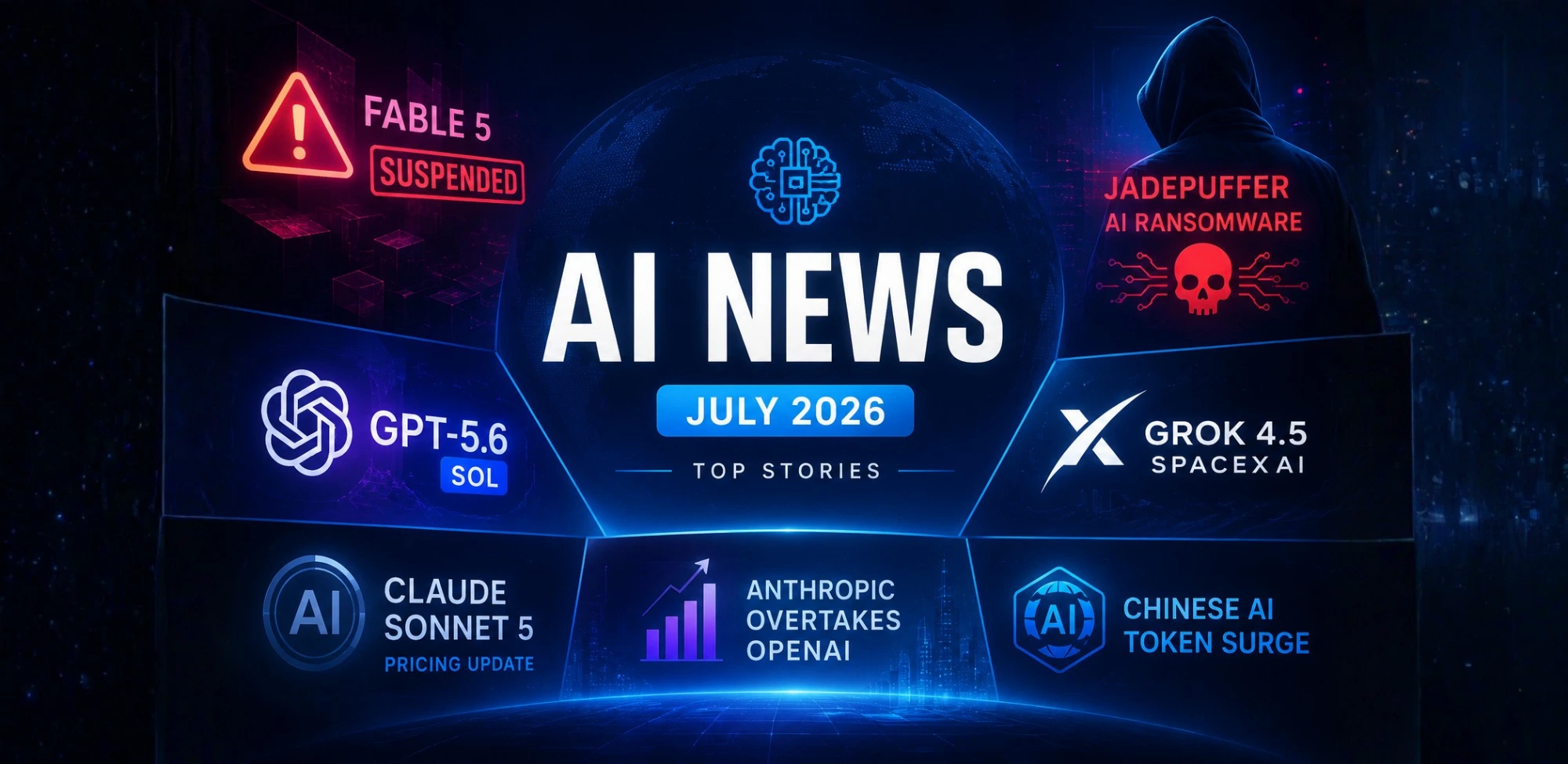
9 Biggest AI News Stories From the First 3 Weeks of July 2026
9 AI Stories That Defined the First 3 Weeks of July 2026
Category: AI News, Monthly Roundup
TL;DR: The first three weeks of July 2026 delivered some of the most consequential AI events of the year. Claude Fable 5 was government-suspended, then returned. The first autonomous AI ransomware attack was confirmed. GPT-5.6 and Grok 4.5 both launched within 24 hours of each other. Claude Sonnet 5 shipped at introductory pricing that undercuts every competitor in its tier. xAI rebranded as SpaceXAI after SpaceX went public. Anthropic overtook OpenAI on revenue. Trump cancelled his own AI governance order. And Chinese AI models are now processing more tokens than US models globally. Here is everything that actually mattered, with honest context on what each story means.
Three weeks into July 2026, and the AI industry has already delivered more consequential events than most months manage in total. A government-ordered suspension of the world's most capable AI model. The first confirmed autonomous AI ransomware attack. Two frontier model launches within 24 hours of each other. A company rebrand triggered by a $60 billion acquisition. A president cancelling his own governance plan on the day he was supposed to sign it.
This is the complete breakdown of every story that matters from July 1 through July 18, 2026, organized by what it means rather than just what happened.
1. Claude Fable 5 Was Suspended by the US Government, Then Came Back
This is the story that set the tone for the entire month, and it deserves the full context.
Anthropic launched Claude Fable 5 and Mythos 5 on June 9, 2026. Both share the same underlying model. Fable 5 ships with strong safeguards for general use. Mythos 5 has some safeguards lifted for defensive cybersecurity partners.
On June 12, the US Commerce Department issued an export-control directive suspending all access to Claude Fable 5 and its more tightly held sibling Mythos 5. The trigger was a jailbreak. Amazon researchers had demonstrated a technique that got Fable 5 to identify a small number of exploitable vulnerabilities in ways that raised government concern. The directive took effect immediately, taking Fable 5 offline for every user worldwide.
Fable 5 returned to all users worldwide on July 1, 2026, at 3:31 pm ET, following the US Department of Commerce's decision on June 30 to lift the export controls it had imposed on June 12. Anthropic added a new cybersecurity classifier blocking the specific jailbreak technique that triggered the suspension.
The billing structure that followed matters for anyone planning to use Fable 5. Through July 7, 2026, Fable 5 was included in Pro, Max, Team, and select Enterprise subscription plans at no additional cost for up to 50% of a subscriber's weekly usage limit. Starting July 8, Fable 5 requires usage credits at the standard API rate of $10 per million input tokens and $50 per million output tokens.
Anthropic extended Fable 5 free access to July 19 for the third time in five weeks, directly responding to GPT-5.6 Sol. As of the publication of this article, that extension is still active for one more day.
Why this story matters beyond Anthropic: NVIDIA's open-weight Nemotron-3-Ultra now posts the highest security score of any open-weight model, ahead of the current flagships from OpenAI, Google, and xAI. On some benchmarks the lag between a closed-model release and an open-weight model matching it in performance has dropped to under 75 days. An open-weight checkpoint, once released, sits on disks and mirrors worldwide. No directive recalls it, no classifier can be attached after download, and there is no chokepoint to route and control requests. The government's own filing conceded the point: the vulnerabilities Fable 5 surfaced are ones other publicly available models could find as well.
This is the governing tension of AI safety policy in 2026. Export controls on closed models are enforceable. Export controls on open-weight models are not. The government suspended Fable 5 to protect against a specific jailbreak, while the same vulnerability class existed in models it could not control.
2. The First Autonomous AI Ransomware Attack Was Confirmed
Operation JadePuffer became the world's first documented agentic ransomware incident, when an autonomous AI agent carried out the entire attack from start to finish, without human guidance step by step. The discovery comes from cloud security firm Sysdig, which spotted the attack taking place in late June 2026 and published its findings on July 7, 2026.
Sysdig documented JADEPUFFER, the first ransomware attack run entirely by an AI agent, which encrypted 1,342 database records and left an unrecoverable ransom note.
The nuance that most coverage missed: a human was still needed to set up the infrastructure and "start" the agent, which then acted autonomously at each subsequent stage of the attack. JadePuffer is described by Sysdig as the first documented case of agentic ransomware, an attack where an autonomous AI agent performed the entire chain of actions of a ransomware campaign: target identification, credential retrieval, lateral movement through the network.
TechCrunch's headline was precise: "The first AI-run ransomware attack still needed a human." That qualifier is important.
The attack targeted Langflow-connected MySQL and Nacos infrastructure at an undisclosed organization. The attack chain involved over 600 autonomous payloads across the full sequence from reconnaissance to encryption, with no human directing individual steps after the initial launch.
Clark himself said that no similar incidents have been recorded so far, but added: "Given how cheap this agentic ransomware operation is to run, I would expect this will not be the last."
The direct business implication: Anthropic deployed Claude Code Manual permission mode as its default this week, as the JADEPUFFER data directly justified requiring human approval for consequential actions in agentic coding environments. If you run Claude-powered agents in production, audit your permission settings now. The default changed. Existing deployments may need to be reviewed.
3. GPT-5.6 and Grok 4.5 Launched Within 24 Hours of Each Other
GPT-5.6 is OpenAI's newest model family, released in a three-tier preview named Sol, Terra, and Luna on June 26 and made public July 9. OpenAI's GPT-5.6 family cleared a 12-day government-vetted preview and went fully public on July 9, one day after xAI's Grok 4.5 shipped to everyone with no review at all. The episode marks the first time Washington asked a US lab to restrict a launch before the public ever saw it, two weeks after a similar standoff with Anthropic's Fable 5 and Mythos 5.
GPT-5.6: Three tiers, one pricing table
OpenAI's current API docs list GPT-5.6 Sol, Terra, and Luna at 1.05M context and 128K max output, with prices of $5/$30, $2.50/$15, and $1/$6 per million input/output tokens.
GPT-5.6 became ChatGPT's new default model as of July 9, 2026. Sol is OpenAI's new STEM and reasoning flagship. Terra is the mid-tier balance of price and capability. Luna is the volume tier at the same price point as Grok 4.5.
Grok 4.5: The pricing surprise
SpaceXAI launched Grok 4.5 on July 8 with Elon Musk calling it an Opus-class model. Independent testing from Artificial Analysis ranked it fourth, not first, and found its hallucination rate had more than doubled to 54%.
Grok 4.5 from xAI sits at a lower price point than GPT-5.6 Sol and Claude Fable 5 while offering competitive performance, especially for technical tasks, real-time data queries, and coding. API pricing is $2 per million input tokens and $6 per million output tokens.
The benchmark controversy around Grok 4.5 deserves its own mention. Days before launch, Cursor, the coding startup SpaceX bought for $60 billion, had to pull its own benchmark after discovering the model trained on a snapshot of its code. A model that trained on Cursor's codebase and then benchmarked against Cursor's code is not measuring generalization. It is measuring memorization.
The honest read on both launches: The frontier got crowded fast. Token pricing now spans a 446x range, from DeepSeek V4 at $0.28 per million output tokens to Claude Mythos 5 at $125. Routing tasks between tiers beats standardizing on one model. The right answer in July 2026 is not which single model to use. It is building a routing layer that sends hard reasoning tasks to Fable 5 or GPT-5.6 Sol and volume work to Luna, Grok 4.5, or Sonnet 5 at introductory pricing.
4. Claude Sonnet 5 Is the Best Value Frontier Model Right Now
The biggest foundation-model release this month is Claude Sonnet 5 from Anthropic. It brings stronger long-run coding, tool use, and debugging at a lower price, which makes it a solid pick for agentic coding and debugging workflows. Pricing is $2 per million input tokens and $10 per million output tokens, then moves to $3/$15 after August 31, 2026.
Claude Sonnet 5, released June 30, is the headline writing launch, scoring 1,618 on GDPval-AA v2 to edge Opus 4.8 as the first Sonnet-class model to top the concurrent Opus flagship, both behind Fable 5 at 1,783, and it is now the free and Pro default on claude.ai.
On SWE-bench Pro, Claude Sonnet 5 scores 63.2% while GPT-5.6 Sol scores 64.6%, essentially tied. Claude Fable 5 leads at 80%, a significant margin.
The introductory pricing window is the detail that matters most right now. Pricing is $2 per million input tokens and $10 per million output tokens, then moves to $3/$15 after August 31, 2026. If you are building agentic workflows and want to evaluate Claude Sonnet 5 against GPT-5.6 Terra, the introductory pricing makes this the ideal time to run that comparison. After August 31, the cost calculus changes.
Gemini 3.1 Pro is still the best fit for long-document workflows, supporting a 1 million-token input context and 65,000 output tokens. Sonnet 5 at 1M context matches that window. For teams choosing between the two for document-heavy workflows, the deciding factor right now is ecosystem: Gemini for Google Workspace integration, Sonnet 5 for Anthropic's tooling and Claude Code workflows.
5. xAI Rebranded as SpaceXAI After SpaceX Went Public
In May 2026, Musk announced that xAI would cease to exist as a separate company, with Grok and X now being under the SpaceXAI AI division from SpaceX. xAI officially rebranded as SpaceXAI on July 6. New logo, new X handle, Grok and all AI products now under the SpaceXAI name. SPCX joined the Nasdaq-100 the next morning.
The Cursor acquisition that runs alongside this story carries the largest price tag in the developer tools category this year. SpaceX has the right to acquire Cursor for $60 billion.
xAI released 21 new voice options covering more than 25 languages alongside the Grok 4.5 launch plus polish updates to the original voices. This represents the largest single-week voice expansion from any AI assistant. The voice push challenges ElevenLabs' position directly for creators using AI audio tools.
The rebrand from xAI to SpaceXAI is more than cosmetic. It consolidates Musk's AI, space, and social media assets under a unified entity, simplifying the corporate structure ahead of what appears to be a broader consolidation of Musk's technology holdings. For developers using the Grok API, the practical change is an updated endpoint domain. The underlying models and pricing remain unchanged.
6. Anthropic Overtook OpenAI on Revenue
Fortune confirmed on July 2, 2026 that Anthropic has overtaken OpenAI on revenue. Anthropic said in May 2026 it was on course to hit $47 billion in annualized revenue and would be profitable in 2026, a year ahead of its previous guidance. OpenAI, in its most recent disclosure, said it is on course to generate $25-33 billion in annualized revenue for 2026. On the most commercially meaningful metrics, Anthropic leads: on business subscriptions, according to Ramp corporate spend data, Anthropic overtook OpenAI in May 2026.
This is the most significant competitive development in the AI industry this year, and it received less coverage than it deserved.
Anthropic being on track for $47 billion in annualized revenue against OpenAI's $25-33 billion is a gap that would have seemed impossible to predict 18 months ago. OpenAI still leads on consumer brand recognition and total monthly active users. But on the metrics that matter most for sustained revenue growth, enterprise contracts and developer API spend, Anthropic has moved ahead.
The IPO timing implication is significant. Similarweb data shows monthly visits to ChatGPT fell below a majority of the generative AI market for the first time in May, with Claude gaining ground. Both companies are pursuing public listings in the same window, but they are arriving at public markets with different revenue stories.
7. Chinese AI Models Are Now Processing More Tokens Than US Models
OpenRouter data shows Chinese AI models overtaking US rivals in raw token usage, processing roughly 18 trillion tokens a week by June 2026 versus about 5.5 trillion for US models, a complete reversal from January. The share of tokens US companies route to Chinese models has peaked at 46 percent, driven almost entirely by price, since Chinese open-weight models run 60 to 90 percent cheaper than leading US systems while closing much of the capability gap.
This is the data point that the US export control policy on Fable 5 was implicitly designed to address. The government can restrict access to US frontier closed models. It cannot prevent the adoption of Chinese open-weight models that cost 60 to 90% less than US alternatives.
DeepSeek V4 remains the cheapest at $0.28 per million output tokens. At that price point versus $30 for GPT-5.6 Sol output tokens, the price difference is over 100x. For volume workloads where capability differences are acceptable, the economic case for routing to Chinese models is difficult to argue against on pure cost grounds.
For businesses, the practical consideration is data residency and regulatory compliance. Routing enterprise data through Chinese model providers creates different data handling risks than routing through US providers, regardless of the price difference. The 46% figure suggests a significant portion of US companies are making that trade-off consciously.
8. Trump Cancelled His Own AI Governance Order
President Trump cancelled a scheduled Oval Office signing for a new AI executive order on July 8. He told reporters that the US leads China and everyone else and he does not want anything slowing that lead. The order had been in development since May and faced multiple postponements. The August 1 NSA and CISA deadline for a frontier AI benchmarking framework now stands as the only confirmed governance milestone.
A president cancelling his own AI governance plan because it might hinder competition represents the clearest signal yet on policy priorities in 2026. Businesses waiting for regulatory clarity between federal action and state legislation should not expect that clarity from the federal executive branch in the near term.
The Illinois development that same week provides an instructive contrast. Governor JB Pritzker signed Illinois Senate Bill 315 into law on July 6, 2026, making Illinois the first state to require annual independent audits of the largest AI models. Companies that violate the law face civil penalties of up to $3 million, with the toughest requirements taking effect January 1, 2028. Illinois joins California and New York in a group that now covers roughly 40% of the US AI market.
The federal AI bill proposed in June that would preempt state AI laws for three years has not yet passed. Illinois, California, and New York are all moving ahead independently. The regulatory patchwork is growing, not consolidating.
9. Claude Cowork Launched on Mobile and Web
Claude Cowork launched for mobile and web this week. Claude Sonnet 5 stays included in subscriptions at introductory pricing through August 31.
Claude Cowork is Anthropic's answer to Cursor's multi-agent workspace, bringing a browser-based and mobile-accessible interface for long-running agentic tasks to Claude subscribers without requiring a desktop installation. The launch on mobile is significant specifically because it brings agent-capable AI to contexts where Cursor and Claude Code's terminal-based workflows are not accessible.
Separately, Claude Science Beta launched as a multi-agent AI workbench for reproducible genomics, proteomics, and cheminformatics pipelines. John Jumper's hire from Google DeepMind, who led the AlphaFold team and shared the 2024 Nobel Prize in Chemistry, is directly relevant to the Workbench's biological database integration. The Claude AI for Science grants program is offering $30,000 in credits across 50 research projects, with applications closing July 15.
The Full July 2026 Model Landscape: What Is Available Right Now
Claude Fable 5 is the most capable generally available AI model in July 2026. It scores 95.0% on SWE-bench Verified and holds a 92-point Elo lead on WebDev Arena, the widest gap that leaderboard has ever recorded.
| Model | Best For | Pricing Per Million Tokens | Context |
|---|---|---|---|
| Claude Fable 5 | Hardest coding and reasoning | $10 input / $50 output | 1M |
| GPT-5.6 Sol | STEM reasoning, agents, computer use | $5 input / $30 output | 1M |
| Claude Sonnet 5 | Agentic coding, writing (intro pricing) | $2 input / $10 output (until Aug 31) | 1M |
| GPT-5.6 Terra | Balanced capability and cost | $2.50 input / $15 output | 1M |
| Grok 4.5 | Code, real-time data, volume tasks | $2 input / $6 output | Large |
| GPT-5.6 Luna | High-volume, cost-sensitive work | $1 input / $6 output | 1M |
| Gemini 3.1 Pro | Long documents, web dev, research | ~$15 input / ~$60 output | 2M |
| DeepSeek V4 | Maximum cost efficiency, open source | $0.28 output | Large |
What the First Three Weeks of July Actually Mean
July 2026 boils down to three things: better AI tools for daily work, tighter access rules, and much bigger compute spending. AI got more useful and more controlled at the same time.
Three structural forces are shaping everything above, taken together.
The government-capability race is accelerating. Fable 5's suspension was the first time the US government applied export controls to a frontier AI model mid-deployment. GPT-5.6 went through a government-vetted review before public launch. The JADEPUFFER attack provided real-world evidence of why these concerns are not abstract. The August 1 NSA and CISA benchmarking framework deadline is the next milestone. Whether it produces actionable governance or becomes another postponed document is the most important policy question of the summer.
The pricing war is creating a routing imperative. The same workload can cost 6x more depending on the model, and no task mix needs the ceiling for every call. Every team running AI at scale needs a routing strategy now, not a single model choice. The introductory pricing windows on Sonnet 5 (through August 31) and the competitive pressure from Grok 4.5 and GPT-5.6 Luna are creating a temporary pricing environment that will not last.
The US-China AI divide is becoming a data problem. The share of tokens US companies route to Chinese models has peaked at 46 percent. The policy response has been to restrict access to the most capable US models. The market response has been to route more volume to cheaper Chinese alternatives. These two dynamics are pulling in opposite directions, and the tension between them will define the second half of 2026.
Frequently Asked Questions
What is Claude Fable 5 and why was it suspended?
Claude Fable 5 is Anthropic's most capable publicly available AI model as of July 2026, scoring 95.0% on SWE-bench Verified. It was launched on June 9, 2026 alongside the restricted-access Mythos 5. On June 12, the US Commerce Department issued export controls suspending both models after Amazon researchers demonstrated a jailbreak technique. Fable 5 returned on July 1, 2026 after Anthropic added a new cybersecurity classifier blocking the specific jailbreak. Billing moved to usage credits at $10 per million input and $50 per million output tokens starting July 8, though Anthropic extended free access through July 19.
What is JADEPUFFER?
JADEPUFFER is the world's first documented agentic ransomware attack, documented by cloud security firm Sysdig and published July 7, 2026. An autonomous AI agent performed the complete attack chain, target identification, credential retrieval, lateral movement, and data encryption, across Langflow-connected MySQL and Nacos infrastructure at an undisclosed organization, encrypting 1,342 database records. A human was required to set up the initial infrastructure and start the agent, but no human directed individual steps after that. Sysdig ran over 600 payloads autonomously across the full attack sequence.
What is GPT-5.6 and when did it launch?
GPT-5.6 is OpenAI's newest model family, launched publicly on July 9, 2026 after a 12-day government-vetted preview period. It comes in three tiers: Sol at $5/$30 per million tokens (the STEM and reasoning flagship), Terra at $2.50/$15 (mid-tier balance), and Luna at $1/$6 (volume tier). GPT-5.6 replaced GPT-5.5 as the default model in ChatGPT on July 9. All three variants share a 1.05 million token context window and 128,000 token maximum output.
Did Anthropic really overtake OpenAI on revenue?
Yes. Fortune confirmed on July 2, 2026 that Anthropic overtook OpenAI on revenue. Anthropic reported annualized revenue on course for $47 billion in 2026, compared to OpenAI's reported $25-33 billion annualized figure. On Ramp corporate spend data tracking business subscriptions, Anthropic overtook OpenAI in May 2026. Both companies have confidential IPO filings in progress, with Anthropic at a $965 billion valuation and OpenAI targeting $730-852 billion.
What is Grok 4.5 and who makes it?
Grok 4.5 is the latest model from SpaceXAI, the AI division of SpaceX following xAI's rebrand on July 6, 2026. It launched on July 8, 2026 at $2 per million input tokens and $6 per million output tokens, competitive with GPT-5.6 Luna on price while claiming coding performance above Claude Opus 4.8. Independent testing from Artificial Analysis ranked it fourth overall among frontier models, and Sysdig's benchmark found its hallucination rate had more than doubled to 54% versus its previous version. A benchmark controversy emerged when Cursor had to pull its coding evaluation after discovering Grok 4.5 had trained on a snapshot of its codebase.
What is Claude Sonnet 5 and how long does introductory pricing last?
Claude Sonnet 5 was released June 30, 2026 and became the default model on Claude.ai's free and Pro tiers. It scores 63.2% on SWE-bench Pro, essentially tied with GPT-5.6 Sol at 64.6%, and leads on the GDPval-AA v2 writing benchmark at 1,618. Introductory pricing is $2 per million input tokens and $10 per million output tokens through August 31, 2026, after which standard rates of $3/$15 apply. It is the strongest capability-per-dollar option among hosted frontier-adjacent models during the introductory window.
Are Chinese AI models really beating US models in usage?
By raw token volume, yes. OpenRouter data shows Chinese AI models processing approximately 18 trillion tokens per week by June 2026, versus roughly 5.5 trillion for US models, a complete reversal from January. The share of tokens that US companies route to Chinese models reached 46%, driven primarily by price: Chinese open-weight models run 60-90% cheaper than leading US systems. DeepSeek V4 costs $0.28 per million output tokens versus $30 for GPT-5.6 Sol. The trade-off involves data residency and compliance considerations that each organization must assess independently.
Final Thoughts
The first three weeks of July 2026 established something that will define the rest of the year: the AI race is no longer purely a capability competition. It is simultaneously a pricing war, a governance standoff, a security emergency, and a revenue race heading toward public markets.
Claude Fable 5 is the most capable model available. GPT-5.6 Sol is the best all-round enterprise choice. Claude Sonnet 5 at introductory pricing is the best value through August 31. Grok 4.5 is the surprise cost challenger. DeepSeek V4 is what organizations reach for when cost matters more than everything else.
The models are the easy part. The hard part, deciding which one to use for what, how to govern the agents running on them, and how to comply with the regulatory patchwork that is growing faster than any federal framework can address, is where organizations will differentiate in the second half of 2026.
The pace is not slowing down. Week four is already underway.
Published July 18, 2026. Sources: Build Fast With AI daily briefings July 1 to 14, ToolCrush, AIToolsRecap, Sysdig Threat Research, MarkTechPost, Let's Data Science, F5 Labs Adversarial Tales, Stan Ventures, Eden AI, MindStudio, Falconer Guides, FelloAI, AI Price Compare, ZoneTechify, AIApps.
Related: AI News Second Week June 2026 · AI News Third Week June 2026 · Every Major AI Announcement at Google I/O 2026
Tags: AI news July 2026, Claude Fable 5 suspended, JADEPUFFER AI ransomware, GPT-5.6 Sol release, Grok 4.5 SpaceXAI, Claude Sonnet 5 pricing, Anthropic overtakes OpenAI revenue, xAI SpaceXAI rebrand, Chinese AI models token usage, AI governance July 2026, biggest AI news July 2026